Every project begins somewhere. Sometimes with a carefully developed business plan, sometimes with an unexpected opportunity, and occasionally with an idea that has been quietly developing for years.
For Haus der Heilpflanzen, the starting point is a longstanding interest in the relationship between plants, human health and the knowledge we have inherited from earlier generations.
Medicinal plants have accompanied human societies for centuries. They have been cultivated in monastery gardens, collected from surrounding landscapes and prepared in countless different ways. Some of their traditional applications have since been supported by scientific research, while others remain uncertain or have been challenged altogether.
It is this relationship between tradition and modern understanding that interests us most.
We believe there is considerable value in preserving botanical knowledge, but also in questioning it. Understanding what a plant has historically been used for is one thing. Understanding what it contains, how it behaves in the human body and whether its proposed benefits are supported by reliable evidence is something quite different.
Haus der Heilpflanzen is growing from that curiosity.
Our ambition is to develop a thoughtful collection of alcohol-free botanical extracts, rooted in European medicinal plant traditions and informed by contemporary scientific knowledge.
The intention is to introduce our first products in 2027.
There is still a great deal to explore before then, and we think that is a story worth sharing.
Why medicinal plants?
There is something particularly interesting about plants that have remained part of traditional medicine across generations.
Take hawthorn, for example. Its leaves, flowers and berries have a long history of use throughout Europe, particularly in preparations associated with heart health.
Today, selected hawthorn extracts have been investigated in clinical trials, producing findings that range from encouraging to inconclusive.
Or consider German chamomile, a familiar plant whose traditional reputation has encouraged researchers to investigate its chemical constituents and potential biological effects.
These examples highlight why medicinal plants remain scientifically interesting.
Their history can help identify areas worth investigating, while modern research provides tools for evaluating the accuracy and limitations of earlier observations.
However, we do not believe that traditional use should be treated as proof of effectiveness.
A plant may have been used for hundreds of years without ever being investigated in a well-designed human trial. Conversely, a particular extract may demonstrate promising laboratory results without producing the same effects in people.
Recognising those distinctions is essential.
Our interest is not in presenting medicinal plants as miraculous alternatives to modern medicine. It is in understanding them as accurately as possible and exploring how that knowledge can inform responsible botanical products.
Rooted in the landscape, informed by research
Germany has a particularly rich relationship with medicinal plants.
From the historical monastery gardens of the Middle Ages to contemporary phytotherapy, botanical knowledge has remained an important part of the country's cultural and medical history.
Many familiar medicinal plants can also be found growing naturally in the surrounding countryside.
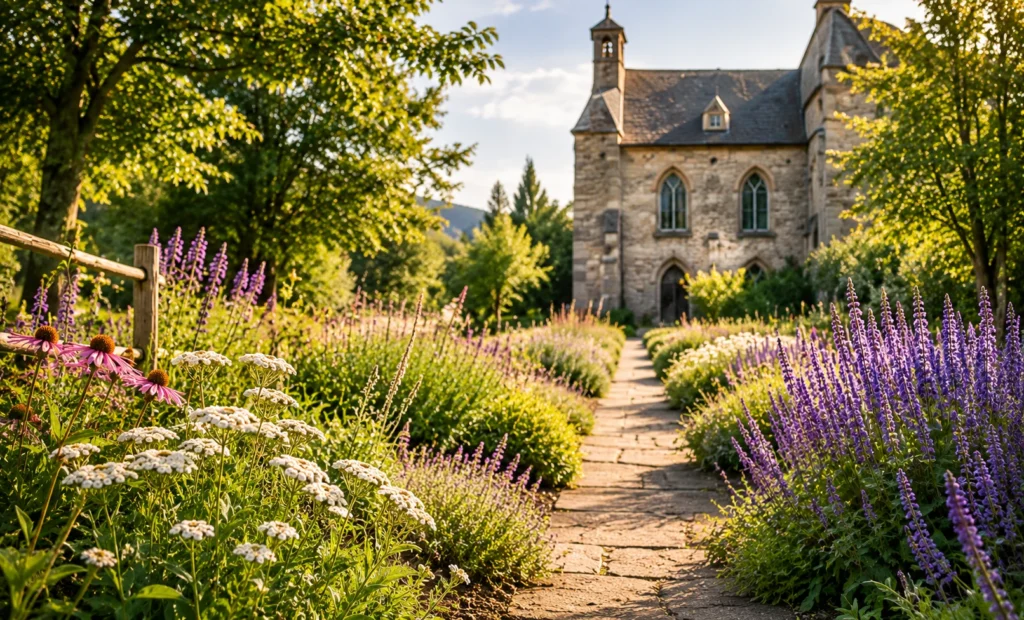
Hawthorn along hedgerows, yarrow in open grasslands, nettles near woodland edges and elderflowers appearing in late spring are all reminders that botanical knowledge begins with the plants themselves.
For us, this connection to the landscape is an important part of the project's identity.
We want to explore opportunities to work with producers and suppliers who understand the plants they cultivate or harvest, and who can provide meaningful information about their origins and quality.
Where possible, we would like to prioritise regional and European sourcing.
However, local sourcing should not be treated as an automatic guarantee of quality or sustainability.
Growing conditions, botanical identification, harvesting practices, contamination risks and processing methods all influence the suitability of raw plant material.
A locally grown plant is not necessarily better than one cultivated elsewhere under carefully controlled conditions.
The challenge is to balance geographic proximity with botanical quality, reliable supply and responsible production.
That balance will help guide our sourcing decisions as the project develops.
Why we are choosing alcohol-free extracts
One of the earliest decisions we made was to focus on alcohol-free botanical preparations.
Traditional herbal tinctures commonly use ethanol because it can extract a wide range of plant constituents and help preserve the finished preparation.
Those are genuine advantages, and alcohol continues to have an important role in botanical extraction.
However, we believe there is value in offering alternatives that do not require consumers to include ethanol in their botanical routines.
People avoid alcohol for many different reasons, including personal preference, cultural beliefs, health considerations or simply because they prefer products without it.
Alcohol-free liquid extracts can also offer a different sensory experience, particularly when formulated using naturally sweeter ingredients such as vegetable glycerin.
For us, the decision is partly about making botanical preparations more accessible and compatible with everyday life.
But it is also a question of formulation.
Modern extraction methods allow manufacturers to work with water, glycerol and other approaches, sometimes supported by technologies designed to improve extraction efficiency.
Scientific studies have shown that glycerol-water systems can successfully recover a variety of plant compounds, including certain polyphenols.
Nevertheless, the effectiveness of an extraction method depends on the plant and the constituents being targeted.
An alcohol-free preparation is not automatically equivalent to an ethanol-based extract, just as two ethanol-based extracts are not necessarily equivalent to one another.
This is why we are placing considerable importance on how our future products are made.
We want to understand which extraction approaches are suitable for each plant, how the resulting composition can be characterised and what quality controls are needed.
Our preference for alcohol-free preparations is clear. The precise methods used to produce them are still being evaluated.
And we believe it is important to make that distinction.
The questions we are still working through
Developing botanical products involves considerably more than selecting a collection of interesting medicinal plants.
Every decision introduces questions that deserve careful consideration.
Which plants should we begin with?
There are hundreds of plants associated with European herbal traditions, but not every one is equally suitable for a modern botanical product.
Some have substantial historical documentation but relatively little human research.
Others have been studied more extensively, although the available evidence may relate to a particular extract or preparation.
We are currently exploring a selection of familiar European medicinal plants, including hawthorn, German chamomile, elderflower, yarrow and ribwort plantain.
The final collection will depend on several factors, including the scientific evidence, regulatory requirements, availability of suitable botanical material and the practicality of developing consistent preparations.
We would rather begin with a carefully considered selection than introduce a large range simply for the sake of variety.
How should the plants be extracted?
This is one of the most important questions.
A botanical extract is not defined solely by the species used. The plant part, extraction solvent, processing conditions and concentration of constituents all contribute to the final preparation.
These differences matter when interpreting research.
If a clinical study investigates a particular standardised extract, its findings cannot automatically be applied to a product manufactured through a different process.
We therefore want to examine extraction options with potential manufacturing partners before finalising our formulations.
For some plants, a water-based approach may be appropriate. Others may require a different process to recover the intended range of constituents.
The objective is not to select one method and apply it indiscriminately to every plant.
It is to understand the characteristics of each botanical material and develop a suitable preparation accordingly.
How do we define quality?
Quality is a word frequently used in the supplement and herbal products industry.
However, it is only meaningful when we can explain what it involves.
For botanical products, quality begins with accurate plant identification and appropriate raw material sourcing.
It also involves manufacturing controls, testing for relevant contaminants and an understanding of the finished extract's composition and stability.
Depending on the plant and preparation, analytical measurements of selected marker compounds may provide additional information about consistency.
These measurements do not necessarily prove clinical effectiveness, but they can help establish that a product is manufactured to a defined specification.
We are currently exploring what level of testing, documentation and transparency can be incorporated into our future production process.
The aim is to make quality something that can be demonstrated, rather than simply claimed.
How should traditional knowledge be communicated?
This question extends beyond product development.
Botanical medicine is surrounded by a mixture of scientific research, historical observations, commercial claims and personal experiences.
Unfortunately, these different forms of information are often presented as though they carry equal scientific weight.
They do not.
A traditional-use record tells us something about a plant's history. A laboratory experiment may reveal a possible biological mechanism. A controlled human study can help assess whether a particular preparation produces a meaningful clinical effect.
Each contributes something different.
We want the information we share to reflect those distinctions, including where evidence is limited or conflicting.
That may occasionally mean presenting a less exciting conclusion than the one found in traditional herbal marketing.
But we believe a more balanced understanding is ultimately more valuable.
Building more than a collection of products
Haus der Heilpflanzen is intended to become more than a place where botanical products are presented.
We also want it to be a place for learning.
Our Journal is an early part of that ambition.
Through articles exploring medicinal plant history, scientific research, extraction methods and botanical traditions, we hope to make complex subjects easier to understand without removing the details that make them meaningful.
A discussion of hawthorn, for example, should not end with a general statement that the plant has traditionally been used for the heart.
It should also consider what human studies have found, where those findings disagree and why the specific preparation matters.
Similarly, an article about alcohol-free botanical extracts should explain both the reasons someone might prefer them and the scientific considerations involved in producing them.
We want readers to leave with a better understanding of the subject, not simply a stronger impression of a brand.
Over time, we hope this educational approach will become as important to Haus der Heilpflanzen as the botanical preparations themselves.
We are also exploring ways to bring this knowledge into more personal, everyday settings, where people can encounter medicinal plants, ask questions and discover their history outside a conventional online shop.
These ideas are still taking shape, but they reflect a broader intention: to make botanical knowledge approachable, practical and connected to everyday experience.
Why 2027?
A launch date can create the impression that everything has already been decided and the remaining work is simply a matter of production.
That is not where we are.
2027 is our target for introducing the first Haus der Heilpflanzen botanical products, but several important decisions remain open.
We are evaluating potential manufacturing relationships, exploring extraction methods, reviewing the suitability of individual plants and considering how the finished products should be presented.
There are also practical requirements involving formulation, testing, regulatory classification, packaging and supply.
Some of these decisions will depend on information that is not yet available.
The final extraction method, for example, should not be selected before we have properly evaluated its suitability for the plants we intend to use.
Similarly, product descriptions and claims must reflect the actual preparations and the evidence supporting them.
We could describe the project as a collection of products waiting to be launched.
But we think it is more accurate to describe it as a botanical project being developed through a series of questions, investigations and decisions.
And we are comfortable with that.
A thoughtful development process is not necessarily the fastest one.
What we hope to bring forward
Looking towards 2027, our ambition is relatively straightforward.
We want to create a collection of carefully developed alcohol-free botanical extracts with a clear connection to medicinal plant heritage and contemporary scientific understanding.
We want to know where our plant materials come from, understand how our preparations are produced and communicate openly about what the available evidence does and does not demonstrate.
We also want to preserve something of the curiosity that started the project.
There is still much to learn about medicinal plants, from the way their constituents interact to how different extraction methods influence the resulting preparations.
Not every traditional claim will withstand scientific scrutiny, and not every botanical preparation will prove suitable for development.
We see that as part of the process rather than a disappointment.
Because the purpose of research is not simply to confirm what we already believe.
It is to help us develop a more accurate understanding.
A journey worth sharing
Haus der Heilpflanzen is still at an early stage.
The ideas are becoming clearer, the questions more specific, and the practical work of turning those ideas into something tangible is underway.
There will undoubtedly be decisions that change as we learn more.
Some plants may prove less suitable than initially expected. Certain extraction methods may need to be reconsidered. And new information may lead us in directions we have not yet anticipated.
Rather than presenting the finished result without the story behind it, we want to share some of that development along the way.
The research, the decisions, the challenges and the reasons behind the choices we eventually make.
For us, this is part of what makes the project meaningful.
Botanical traditions have always developed through observation, experience and the gradual sharing of knowledge.
Today, we have the opportunity to bring more rigorous scientific methods into that process while preserving the curiosity and respect for the natural world that helped those traditions emerge.
That is the idea guiding Haus der Heilpflanzen towards 2027.
Not simply to bring another collection of herbal products to market, but to create something thoughtful, transparent and grounded in a deeper understanding of the plants themselves.
And although the destination is beginning to take shape, there is still plenty to discover along the way.
Frequently asked questions
What is Haus der Heilpflanzen?
Haus der Heilpflanzen is a botanical project in development, focused on medicinal plant knowledge, scientific understanding and a planned collection of alcohol-free botanical extracts. The project also aims to make information about botanical heritage and research more accessible through educational content.
When will Haus der Heilpflanzen launch?
The current target is 2027. The exact launch date will depend on product development, manufacturing arrangements, quality assessment and relevant regulatory requirements.
Why are you developing alcohol-free botanical extracts?
We want to offer botanical preparations that do not require consumers to include ethanol in their daily routines. Alcohol-free extraction can also provide different formulation and sensory characteristics. The precise method will be selected according to the botanical material and quality requirements.
Will the plants be sourced locally in Germany?
Our preference is to explore regional and European sourcing where practical. However, final sourcing decisions will also depend on botanical quality, responsible production, availability and consistency. We do not consider local origin alone a guarantee of quality.
Which medicinal plants will be included?
We are exploring several European medicinal plants, including hawthorn, German chamomile, elderflower, yarrow and ribwort plantain. The final collection has not yet been confirmed.
Will your products be supported by scientific research?
Scientific evidence is central to our development approach. However, the amount and quality of research vary between medicinal plants and preparations. We intend to distinguish clearly between traditional use, laboratory findings and clinical evidence, without treating research on one extract as proof of effectiveness for a different formulation.
Editorial note: This article describes a botanical project currently in development. The proposed products, sourcing arrangements, formulations and launch plans remain subject to further investigation and regulatory review. No specific product characteristics or therapeutic effects are implied or guaranteed.