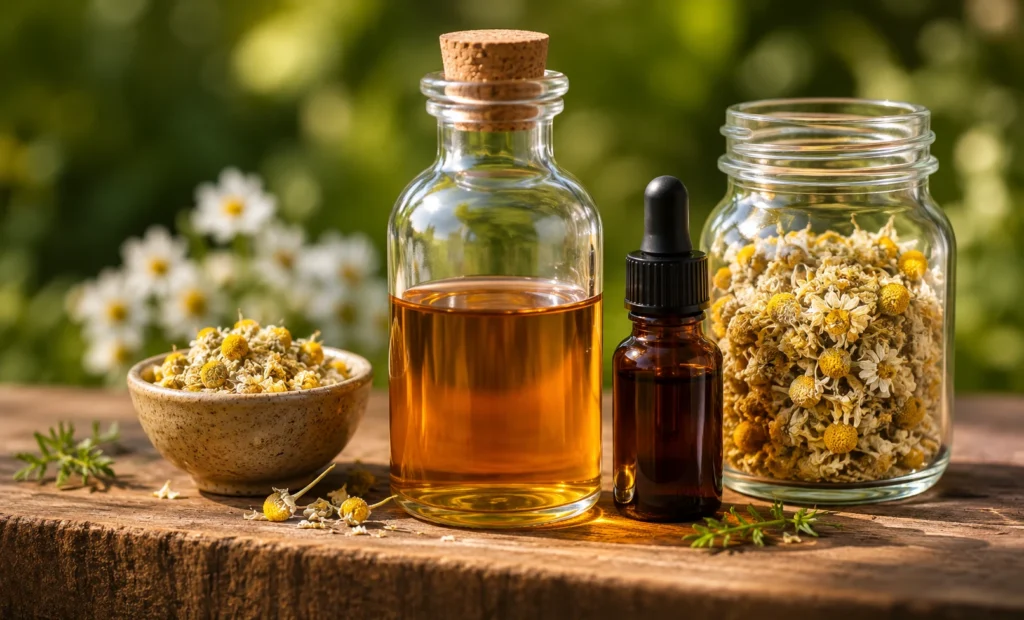
For centuries, medicinal plants have been prepared in different ways. Some were dried and steeped in hot water, others infused in oil or preserved in alcohol. Each method developed for a reason, whether to extract particular plant compounds, preserve the preparation or make it easier to use.
Alcohol-based tinctures eventually became one of the most familiar forms of herbal medicine. They offered a practical way to concentrate plant constituents and preserve extracts for extended periods.
But alcohol is not the only way to extract compounds from medicinal plants.
Today, advances in botanical extraction allow manufacturers to work with water, glycerol and other solvents, sometimes supported by technologies that improve extraction efficiency. These methods have opened up new possibilities for producing concentrated liquid preparations without relying on ethanol.
For people who prefer to avoid alcohol, whether for health, personal, cultural or lifestyle reasons, this is an important development.
However, the benefits of alcohol-free botanical extracts go beyond simply removing an ingredient. Their appeal also lies in how they can fit into everyday routines, the flexibility they offer in formulation and the opportunity to develop products with carefully defined botanical compositions.
At the same time, alcohol-free should not automatically be interpreted as more effective, safer in every circumstance or scientifically superior.
To understand what makes a good botanical extract, we first need to examine what extraction actually involves.
What happens when we extract a medicinal plant?
A medicinal plant contains a complex mixture of naturally occurring compounds. Some contribute to its colour, aroma or flavour, while others may influence biological processes in the human body.
These include substances such as flavonoids, phenolic acids, tannins, terpenes and numerous other phytochemicals.
However, these compounds do not all behave in the same way.
Some dissolve readily in water, while others require different solvents or processing conditions to be extracted efficiently.
Extraction is the process of separating selected constituents from plant material and transferring them into a liquid or another concentrated preparation.
The process might appear straightforward, but the outcome can be influenced by several factors.
The botanical species, part of the plant used, growing conditions, harvesting time and drying method can all affect its composition before extraction has even begun.
The choice of solvent then determines which compounds are more readily extracted.
Temperature, duration, particle size and the ratio of plant material to extraction liquid introduce further variables.
Consequently, two extracts produced from the same medicinal plant may differ considerably in their chemical composition.
This is an important distinction because the quality of a botanical extract cannot be judged simply by the name of the plant on the bottle.
It also depends on how that plant has been processed.
Why has alcohol traditionally been used?
Alcohol, more precisely ethanol, has played a substantial role in herbal preparations because it possesses several useful properties.
It can dissolve a wide range of plant constituents, including some that are not easily extracted using water alone.
When combined with water, ethanol can provide a versatile extraction medium. Different concentrations influence which compounds are extracted and in what proportions.
Alcohol can also help preserve liquid preparations by limiting the growth of certain microorganisms when present at sufficient concentrations.
These characteristics explain why ethanol-based tinctures became so widely established.
However, a useful manufacturing ingredient is not necessarily an ingredient that every consumer wants in their finished product.
And while alcohol can be an effective extraction solvent, that does not make it essential for every medicinal plant or botanical compound.
The more interesting question is whether alternative methods can produce extracts with appropriate composition, stability and quality.
Research increasingly suggests that, for many classes of plant compounds, they can.
How are alcohol-free botanical extracts made?
Alcohol-free botanical extracts can be produced using several different approaches.
The method selected depends on the characteristics of the plant, the compounds being targeted and the intended finished product.
Water extraction
Water is one of the oldest and most familiar extraction solvents.
Herbal teas are a simple example. Plant material is exposed to water, allowing soluble constituents to move into the liquid.
More sophisticated water-based methods use controlled temperatures, extraction times and processing conditions to improve consistency.
Water is particularly useful for extracting certain polar compounds, including some phenolic compounds, polysaccharides and other water-soluble substances.
Its limitations arise when important constituents have poor water solubility.
For this reason, water extraction is effective for some botanical applications but not necessarily suitable for every plant or intended composition.
Glycerin and water extraction
Vegetable glycerin, also known as glycerol, offers another approach.
Glycerol is a clear, viscous liquid with a naturally sweet taste. It is widely used in food, pharmaceutical and cosmetic formulations.
When combined with water, it can function as an extraction medium for various plant compounds.
Alcohol-free botanical extracts made using glycerin are often referred to as glycerites.
One interesting characteristic of glycerol is its ability to dissolve certain compounds that may not be extracted as effectively using water alone.
A scientific review published in Molecules examined glycerol-based solvents for the recovery of polyphenols from plant materials. The researchers identified considerable potential for glycerol-based extraction, while also highlighting the importance of optimising temperature, solvent concentration and processing conditions.
The findings are interesting because they demonstrate that ethanol is not automatically necessary to recover compounds of botanical interest.
However, glycerin is not a universal replacement for ethanol. Its higher viscosity can make extraction slower or more difficult under certain conditions, and different botanical constituents respond differently to each solvent.
The effectiveness of the method must therefore be assessed individually.
Modern extraction technologies
Extraction does not depend solely on the solvent.
Modern techniques can improve how effectively compounds are released from plant material.
Ultrasound-assisted extraction, for example, uses sound waves to create microscopic changes within the liquid that can improve solvent penetration and the release of plant constituents.
Other methods use controlled pressure, temperature or specialised processing equipment.
These technologies can sometimes improve extraction yields or reduce processing time without requiring ethanol.
However, the advantages depend on the plant and the method used.
An advanced extraction process is not automatically better simply because it sounds more sophisticated.
What matters is whether it produces a suitable, consistent and well-characterised extract.
Why choose alcohol-free botanical extracts?
The decision to avoid alcohol is often presented as a matter of personal preference.
While this is certainly one reason, there are several practical and potentially meaningful advantages to an alcohol-free formulation.
1. Avoiding unnecessary alcohol exposure
The most straightforward benefit is also one of the most important: a genuinely alcohol-free formulation allows consumers to use a botanical product without consuming ethanol from that product.
Alcohol is a biologically active substance.
Its effects on human health have been extensively studied, and the World Health Organization has concluded that alcohol consumption carries health risks, including an increased risk of several cancers.
The relationship between alcohol consumption and health risk is influenced by the amount consumed and the frequency of exposure. The WHO also notes that no level of alcohol consumption has been established as completely risk-free. [1]
However, it is important to distinguish between the quantities of alcohol consumed in beverages and the much smaller amounts that may be present in individual servings of herbal tinctures.
The evidence on alcohol-related disease cannot simply be used to claim that consuming a few drops of an alcohol-based herbal preparation produces a measurable long-term health risk.
Nevertheless, if a botanical product can be formulated appropriately without ethanol, avoiding that additional exposure is a reasonable choice.
For consumers who already make conscious decisions about alcohol consumption, an alcohol-free botanical extract provides a way to apply the same preference to their herbal products.
2. Suitable for alcohol-free lifestyles
Not everyone avoids alcohol solely for medical reasons.
Some people abstain because of religious or cultural beliefs, personal values, recovery from alcohol dependence or simply because they prefer not to consume it.
For these individuals, conventional alcohol-based tinctures may be undesirable regardless of the actual quantity of ethanol present.
Alcohol-free extracts provide an alternative that better accommodates these preferences.
This is one of the strongest arguments for their development.
Botanical products should not necessarily require people to compromise other lifestyle choices simply because ethanol has traditionally been used as the extraction medium.
An appropriately formulated alcohol-free preparation makes herbal products accessible to a wider range of consumers.
For people who must avoid even trace quantities of ethanol, however, the specific product should be assessed carefully. Not all products marketed as alcohol-free necessarily follow the same manufacturing processes or contain exactly zero residual ethanol.
3. A different sensory experience
Alcohol-based tinctures can have a distinctive taste and produce a warming or burning sensation in the mouth, particularly when the ethanol concentration is relatively high.
For some consumers, this is an accepted characteristic of traditional herbal preparations.
For others, it can make regular use unpleasant.
Glycerin-based extracts often have a naturally sweeter flavour and may provide a gentler sensory experience.
This can be particularly relevant when botanical extracts are taken directly or mixed into drinks.
Taste is not a measure of clinical effectiveness, but it can influence whether someone finds a product pleasant and practical to use.
A formulation that fits naturally into a daily routine may be more appealing than one that requires consumers to tolerate a flavour they dislike.
4. Greater flexibility for everyday use
Alcohol-free liquid extracts can offer considerable flexibility.
Depending on the formulation and product directions, they may be added to water, herbal infusions or other suitable drinks.
This creates opportunities to incorporate botanical preparations into everyday routines without introducing ethanol into the beverage.
For a brand focused on making traditional plant knowledge accessible, this is particularly relevant.
It also allows botanical preparations to be experienced in ways that feel more compatible with contemporary preferences.
However, the suitability of mixing an extract into hot or cold drinks depends on its stability, recommended use and intended dosage.
These characteristics need to be established for the individual product rather than assumed for all alcohol-free extracts.
5. More formulation choices without ethanol
Choosing alcohol-free extraction does not mean abandoning the chemistry behind traditional herbal preparations.
Instead, it encourages a more considered approach to selecting the extraction method.
Some botanical compounds are well suited to water-based extraction. Others may be extracted effectively using glycerol-water mixtures or different processing technologies.
Research involving peppermint and common nettle, for example, found that optimised glycerol-water systems frequently achieved higher concentrations of measured polyphenols, flavonoids and chlorophyll than the comparison solvents used in the experiments. [2]
Another study involving Echinacea purpurea found that glycerol-water mixtures could perform comparably to ethanol-water mixtures for the extraction of specific caffeic acid derivatives. [3]
These findings do not demonstrate that glycerin extraction is always superior.
They do, however, challenge the assumption that alcohol must be present to obtain useful botanical constituents.
They also illustrate why extraction should be designed around the individual plant and the desired chemical profile rather than relying on one method for every species.
6. Potential advantages in processing and solvent handling
There are also manufacturing considerations.
Ethanol is volatile and flammable, requiring appropriate precautions during storage and processing.
Glycerol, by contrast, has very low volatility and is considerably less flammable under ordinary processing conditions.
Research into glycerol-based extraction has therefore identified potential advantages from a green-chemistry and industrial handling perspective. [4]
Some glycerol can also be produced from renewable feedstocks.
These characteristics may support more sustainable manufacturing approaches, particularly when combined with responsibly sourced ingredients and efficient processing methods.
However, sustainability cannot be determined by the solvent alone.
Energy consumption, agricultural production, transport, packaging and waste management all contribute to the environmental impact of a finished product.
An alcohol-free formulation is therefore not automatically more environmentally friendly, but it may offer useful opportunities when considered as part of the entire production process.
Does alcohol-free mean less effective?
This is perhaps the most important question.
There is no scientific basis for assuming that a botanical extract is inherently less effective simply because it does not contain alcohol.
Equally, removing ethanol does not automatically make a preparation more effective.
The relevant question is whether the chosen extraction method successfully recovers the compounds of interest at suitable concentrations.
Research into glycerol-based extraction demonstrates that alcohol-free methods can be highly effective at extracting certain plant compounds.
However, laboratory measurements of extraction yield do not necessarily establish how a preparation will affect human health.
An extract containing a high concentration of polyphenols, for example, is not automatically clinically superior to one containing a lower concentration.
The biological importance of individual constituents, their availability to the body and the evidence supporting the preparation must also be considered.
This is particularly relevant when interpreting clinical studies of herbal medicine.
If a trial investigates a specific ethanol-derived hawthorn extract, its findings apply to that preparation under the conditions studied.
They cannot automatically be transferred to another extract, whether alcohol-based or alcohol-free.
The same principle works in both directions.
A poorly characterised ethanol extract does not become clinically validated simply because another ethanol-derived preparation has been studied.
Ultimately, the solvent is one part of a larger scientific picture.
What determines the value of a botanical extract is not whether it contains alcohol, but its composition, quality, consistency and the evidence supporting its intended use.
What determines the quality of an alcohol-free extract?
Removing alcohol creates opportunities, but it also places greater importance on appropriate formulation and quality controls.
Ethanol can act as a preservative at suitable concentrations. Without it, manufacturers need to ensure that the finished product remains microbiologically safe and chemically stable throughout its intended shelf life.
Glycerol can contribute to preservation under appropriate conditions, but its presence alone does not guarantee that a formulation is adequately protected from microbial growth.
This is why alcohol-free extracts should be evaluated according to clear quality criteria.
Botanical identity and sourcing
The first requirement is knowing exactly which plant is being used.
Closely related species can contain different concentrations of constituents, and certain botanical materials may be substituted or incorrectly identified.
Accurate species identification and appropriate sourcing are therefore fundamental.
Growing conditions, harvesting practices and storage also influence quality.
Extraction method and composition
A manufacturer should understand how the extraction process influences the finished product.
Relevant information may include the plant part used, extraction solvent, plant-to-extract ratio and, where appropriate, measured marker compounds.
A higher extraction ratio should not automatically be interpreted as a better or more potent product.
It indicates something about the relationship between the starting material and the resulting preparation, but does not independently establish therapeutic value.
Microbiological safety and stability
Alcohol-free liquid preparations require appropriate controls against microbial contamination.
These may involve formulation design, suitable manufacturing conditions, microbiological testing and stability assessments.
The European Medicines Agency's guidance on herbal medicinal product quality addresses several of these considerations, including contaminants, water quality, product specifications and stability. [5]
The essential point is that an extract should remain safe and consistent throughout its stated shelf life, not simply meet expectations immediately after production.
Testing and transparency
Analytical testing can help confirm the identity and composition of botanical preparations.
Depending on the plant and product, manufacturers may test for selected constituents, microbial contamination, heavy metals, pesticide residues or other relevant quality parameters.
Such testing does not prove that a botanical product will produce a particular health benefit.
It does, however, provide greater confidence that the product contains what it is intended to contain and meets appropriate quality standards.
This distinction is worth preserving.
Good manufacturing quality and clinical effectiveness are related considerations, but they are not the same thing.
Why we have chosen an alcohol-free approach
At Haus der Heilpflanzen, our interest in medicinal plants begins with an appreciation of their history, but it does not end there.
Traditional preparations developed within the scientific and practical limitations of their time. Alcohol became widely used because it offered genuine advantages in extraction and preservation.
Those advantages remain relevant today.
However, modern botanical science gives us opportunities to examine alternative methods and select formulations that better reflect contemporary preferences.
We believe alcohol-free botanical extracts offer an attractive balance between tradition and modern product development.
They allow us to focus on medicinal plants without requiring consumers to include ethanol in their botanical routines.
They can offer a more pleasant sensory experience, greater flexibility in everyday use and compatibility with different personal and cultural preferences.
Importantly, research also demonstrates that alcohol-free extraction methods are capable of recovering a wide range of botanically interesting compounds.
This does not mean every plant is suited to the same extraction method, or that alcohol-free formulations are automatically equivalent to clinically studied extracts.
It means that alcohol-free extraction is a scientifically legitimate approach deserving the same attention to formulation, quality and evidence as any other botanical preparation.
As we develop our range, the selection of appropriate extraction methods, botanical identity and quality standards will be important considerations.
Our intention is not to dismiss traditional tinctures, nor to suggest that removing alcohol alone makes a product superior.
It is to use modern botanical knowledge to develop preparations that are consistent with our values and relevant to how people choose to live today.
A different approach, built on the same botanical tradition
The history of herbal medicine is a history of adaptation.
Methods of cultivation, harvesting, preparation and preservation have evolved as our understanding of plants and human physiology has developed.
Alcohol-free extraction represents another step in that process.
It does not reject traditional herbal knowledge. Instead, it builds upon it by exploring how botanical compounds can be extracted and formulated in different ways.
For consumers, the benefits are tangible: the ability to avoid ethanol, a different taste experience and greater choice in how botanical preparations fit into everyday life.
For manufacturers, the opportunities lie in thoughtful formulation, appropriate analytical testing and a better understanding of how extraction influences the finished product.
And for botanical research, it reinforces an important principle.
The quality of an extract should never be judged by its solvent alone.
It should be understood through the plant from which it originates, the methods used to prepare it and the evidence that supports its composition, safety and intended purpose.
At Haus der Heilpflanzen, this is the approach we want to take.
Respecting the knowledge passed down through generations, while using modern scientific understanding to question, refine and improve how medicinal plants are prepared.
Because preserving botanical tradition does not mean that every preparation must remain unchanged.
Sometimes, moving a tradition forward means finding a different way to work with the same plants.
Frequently asked questions
What is an alcohol-free botanical extract?
An alcohol-free botanical extract is a preparation made from plant material that is formulated without ethanol in the finished product. Methods can include water-based and glycerol-based extraction. However, the term should be supported by appropriate manufacturing information and, where necessary, residual alcohol testing.
Are alcohol-free herbal tinctures as effective as alcohol-based tinctures?
They can extract many of the same types of plant compounds, but effectiveness depends on the species, extraction process, chemical composition and intended use. Some laboratory studies have demonstrated comparable or higher extraction yields using glycerol-water mixtures. This does not automatically establish equivalent clinical effectiveness.
What is vegetable glycerin, and why is it used in herbal extracts?
Vegetable glycerin is a form of glycerol obtained from plant-derived feedstocks. It is a clear, naturally sweet liquid used in food, pharmaceutical and cosmetic formulations. When mixed with water, it can extract certain botanical compounds and provide a liquid base without ethanol.
Are alcohol-free botanical extracts better for your health?
They offer the clear benefit of avoiding ethanol exposure from that product, which may be especially valuable for people who abstain from alcohol. However, an alcohol-free botanical extract is not automatically healthier, safer or more effective in every respect. Its overall safety depends on the plant, formulation, dosage and individual circumstances.
Can alcohol-free botanical extracts be taken by children or during pregnancy?
Alcohol-free does not automatically mean suitable for children, pregnancy or breastfeeding. Some botanical compounds may be unsuitable for these groups regardless of the extraction solvent. Safety must be assessed for the specific plant and preparation, and professional medical advice may be necessary.
Do alcohol-free extracts contain preservatives?
Some do, while others rely on formulation characteristics, processing methods or other preservation strategies. The presence of glycerin alone does not guarantee microbiological stability. Manufacturers should establish product safety and shelf life through suitable testing.
What should I look for when choosing an alcohol-free botanical extract?
Look for accurate botanical identification, clearly described ingredients, transparent extraction information, appropriate quality controls and reliable manufacturing standards. Where relevant, information about marker compounds, microbiological testing and residual ethanol can provide additional reassurance.
References and further reading
1. World Health Organization (2023). No level of alcohol consumption is safe for our health. WHO Regional Office for Europe. https://www.who.int/europe/news/item/04-01-2023-no-level-of-alcohol-consumption-is-safe-for-our-health
2. Optimization of Glycerol–Water Extraction of Selected Bioactive Compounds from Peppermint and Common Nettle (2021). Antioxidants, 10(5), 817. https://doi.org/10.3390/antiox10050817
3. Comparison of Maceration and Ultrasonication for Green Extraction of Phenolic Acids from Echinacea purpurea Aerial Parts (2020). https://pmc.ncbi.nlm.nih.gov/articles/PMC7663822/
4. Glycerol and Glycerol-Based Deep Eutectic Mixtures as Emerging Green Solvents for Polyphenol Extraction: The Evidence So Far (2020). Molecules, 25(24), 5842. https://doi.org/10.3390/molecules25245842
5. European Medicines Agency (2022). Guideline on quality of herbal medicinal products/traditional herbal medicinal products, Revision 3. https://www.ema.europa.eu/en/scientific-guidelines/quality-herbal-medicinal-products-traditional-herbal-medicinal-products
6. European Medicines Agency (2015). Reflection paper on microbiological aspects of herbal medicinal products and traditional herbal medicinal products. https://www.ema.europa.eu/en/scientific-guidelines/microbiological-aspects-herbal-medicinal-products-traditional-herbal-medicinal-products
Editorial note: This article explains botanical extraction principles and formulation considerations. It does not establish the clinical effectiveness or safety of any particular product. Specific manufacturing characteristics and alcohol-free claims should be verified against the final formulation and supporting test documentation.