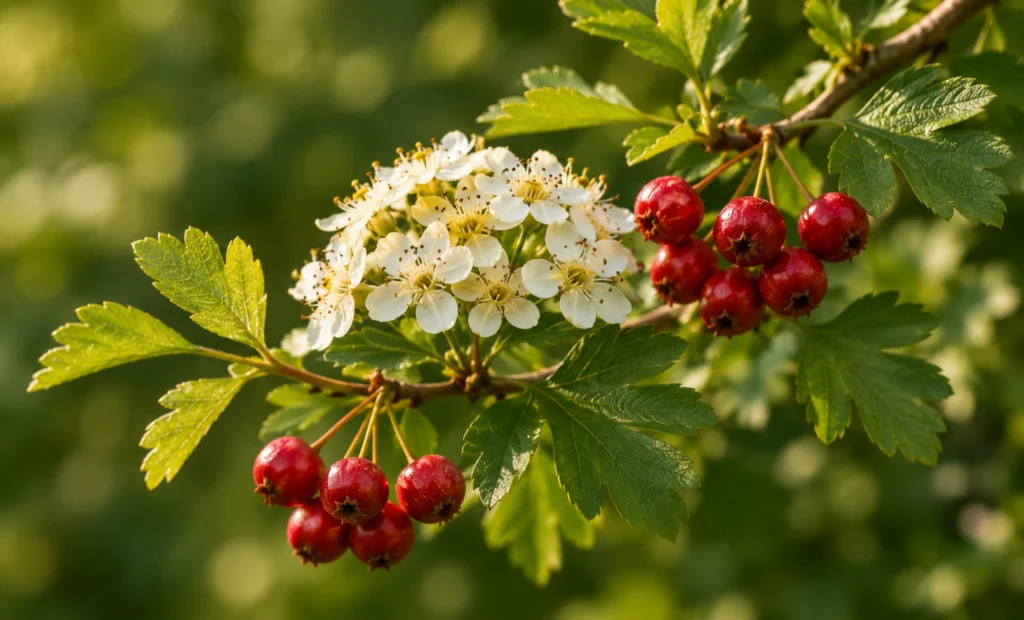
Hawthorn is one of those plants that most people have encountered without necessarily knowing much about it. Its white blossoms appear along hedgerows in spring, followed by small red fruits as summer gives way to autumn. In Germany, where it is commonly known as Weißdorn, hawthorn has long been part of the rural landscape and European herbal tradition.
For generations, different parts of the plant have been used in preparations associated with circulation, digestion and, perhaps most notably, heart health.
Today, hawthorn occupies an interesting position between traditional herbal medicine and modern scientific research. Unlike many medicinal plants whose reputations rest almost entirely on historical use, certain hawthorn preparations have been investigated in controlled clinical trials involving people with cardiovascular disease.
Some of these studies have produced encouraging findings. Others have shown little or no meaningful benefit.
At first glance, the evidence may appear contradictory. However, a closer examination reveals that the studies often investigate different patient populations, treatment durations and, importantly, different preparations of the plant.
This raises an interesting question: when research suggests that hawthorn may have a particular effect, what exactly has been studied, and how much of that evidence can reasonably be applied to other hawthorn products?
Understanding this distinction is essential if we want to appreciate both the historical significance of hawthorn and its potential place within modern, evidence-based herbal medicine.
A familiar plant with a long medicinal history
Hawthorn belongs to the genus Crataegus, a group of shrubs and small trees within the rose family (Rosaceae). Two species particularly familiar in Germany are common hawthorn (Crataegus monogyna) and Midland hawthorn (Crataegus laevigata).
Both are characterised by thorny branches, clusters of white or occasionally pinkish flowers, and red fruits commonly referred to as haws.
Hawthorn has been used for various purposes across European folk medicine. The berries were incorporated into foods and traditional preparations, while the leaves and flowers became particularly associated with remedies intended to support cardiovascular function.
Its use for heart-related complaints became especially prominent in European herbal medicine during the nineteenth and twentieth centuries.
However, as with many traditional medicinal plants, the historical record does not provide the same level of evidence that we would expect from modern clinical research.
A remedy may have been used consistently for generations, but this alone cannot establish whether it produced a meaningful therapeutic effect. Improvements could have resulted from the natural progression of an illness, other treatments or individual expectations.
Nevertheless, historical use provides something valuable: an indication of which plants and preparations earlier practitioners considered worth investigating.
For hawthorn, that historical interest eventually led researchers to examine its chemical composition and its possible influence on cardiovascular physiology.
What makes hawthorn scientifically interesting?
The medicinal interest in hawthorn is largely associated with several groups of naturally occurring plant compounds.
Among the most frequently investigated are flavonoids and oligomeric procyanidins, often abbreviated as OPCs. These belong to the broader family of polyphenolic compounds found in many plants.
Researchers have investigated their potential effects on processes involved in cardiovascular function, including blood vessel relaxation, oxidative stress and the activity of certain cellular signalling pathways.
Some laboratory studies suggest that specific hawthorn extracts may influence the function of vascular endothelial cells, which line the inside of blood vessels, as well as mechanisms involved in cardiac muscle contraction.
These findings provide plausible explanations for why hawthorn attracted scientific interest in the first place.
However, there is an important distinction between observing a biological effect in laboratory conditions and demonstrating a meaningful health benefit in humans.
A compound may produce a measurable response in isolated cells or animal models without necessarily reaching the same concentrations, or producing the same effect, when consumed as a herbal preparation.
The human body introduces additional variables, including digestion, absorption, metabolism and interactions with other substances.
Consequently, although laboratory research helps us understand how hawthorn might influence cardiovascular physiology, it cannot establish whether taking a hawthorn preparation improves heart health.
For that, we must examine clinical studies involving humans.
What have human studies actually found?
Hawthorn has been investigated in several clinical trials, particularly among patients with chronic heart failure.
Heart failure is a condition in which the heart cannot pump blood as effectively as the body requires. Depending on its severity, it can cause fatigue, breathlessness, reduced exercise capacity and fluid retention.
The studies examining hawthorn have generally investigated whether particular extracts could provide additional benefits alongside conventional medical treatment.
This distinction is important. Hawthorn was not generally being evaluated as a replacement for established heart failure medication.
Early clinical trials: Encouraging results
In 2008, Guo, Pittler and Ernst published a systematic review in the Cochrane Database of Systematic Reviews examining the effectiveness of hawthorn extracts in patients with chronic heart failure.
The review included 14 clinical trials, with 10 studies involving 855 participants contributing data suitable for meta-analysis.
The researchers found that hawthorn extract was associated with improvements in several outcomes compared with placebo.
These included measures of exercise capacity and symptoms such as fatigue and shortness of breath.
For example, the pooled analysis reported an improvement in maximal workload of approximately 5.35 watts compared with placebo, based on studies involving 380 participants.
Although statistically significant, this was a relatively modest difference, and its practical importance for individual patients requires careful consideration.
The researchers concluded that hawthorn extract appeared to offer some benefits in symptom control and physiological outcomes when used alongside conventional treatment.
However, the review also highlighted an important limitation.
Most of the included studies were relatively small and focused on symptoms or functional measurements rather than longer-term outcomes such as hospitalisation or survival.
In other words, even if a preparation improved exercise tolerance or reduced feelings of breathlessness, this did not necessarily mean it altered the progression of the underlying disease.
That distinction would become particularly relevant in subsequent research.
The SPICE trial: A larger and more demanding test
One of the most important investigations into hawthorn was the SPICE trial, published by Holubarsch and colleagues in 2008.
Unlike many earlier studies, this was a large, randomised, double-blind, placebo-controlled trial involving 2,681 patients with chronic heart failure.
The participants received either a standardised hawthorn extract known as WS 1442 or a placebo, alongside their existing medical treatment.
The hawthorn group received 900 mg of WS 1442 daily, and patients were followed for approximately two years.
The primary aim was to determine whether the extract reduced the occurrence of significant cardiac events, rather than simply improving symptoms.
The results were less encouraging than those of some earlier investigations.
The proportion of patients experiencing the primary cardiac outcome was 27.9% in the hawthorn group compared with 28.9% in the placebo group.
This difference was not statistically significant (p = 0.476).
In practical terms, the study did not demonstrate that WS 1442 significantly reduced the overall risk of the cardiac events included in its primary outcome.
An analysis of a subgroup of patients with less severely reduced left ventricular function suggested a possible reduction in sudden cardiac death.
However, subgroup findings require particular caution. They involve smaller numbers of participants and may produce apparently positive results even when the overall study does not demonstrate a significant benefit.
Consequently, the subgroup result should be viewed as a finding worth further investigation rather than definitive proof of a protective effect.
The SPICE trial is particularly valuable because it illustrates why large clinical studies are necessary.
An intervention may improve certain symptoms or physiological measurements without necessarily reducing major clinical events.
The HERB CHF trial: Questioning the earlier findings
Further uncertainty emerged from the HERB CHF trial, published in 2009.
This randomised, double-blind, placebo-controlled study involved 120 patients with chronic heart failure who were already receiving conventional medical treatment.
Participants received either hawthorn extract or placebo for six months.
The researchers assessed several outcomes, including walking distance, exercise capacity, quality of life and cardiac function.
Unlike some earlier studies, the trial found no statistically significant improvement in walking distance, quality of life or most other functional measurements.
A modest improvement in left ventricular ejection fraction, a measure of the proportion of blood pumped out of the heart with each contraction, was observed in the hawthorn group.
However, this finding did not translate into clear improvements in the principal clinical outcomes examined.
The researchers therefore concluded that hawthorn did not provide meaningful symptomatic or functional benefits when added to standard medical treatment in their study population.
It is worth noting that this trial was considerably smaller than SPICE, but its findings nevertheless add to the uncertainty surrounding hawthorn's clinical effectiveness.
What should we conclude from these studies?
Taken together, the research suggests a more complicated picture than either enthusiastic endorsements or outright dismissals of hawthorn would imply.
Earlier trials and pooled analyses identified improvements in certain symptoms and measures of exercise capacity.
However, larger or more recent controlled investigations have not consistently reproduced those benefits or demonstrated reductions in major cardiovascular events.
It would therefore be inaccurate to claim that hawthorn has been proven effective for treating chronic heart failure.
Equally, the clinical research should not simply be dismissed. The findings provide valuable information about the effects, limitations and safety of particular hawthorn preparations.
The most reasonable interpretation is that some extracts have demonstrated potentially useful biological or symptomatic effects, but the clinical evidence remains insufficient and inconsistent for many broader therapeutic claims.
This interpretation is also consistent with the position of the US National Center for Complementary and Integrative Health, which describes the evidence for hawthorn in heart failure as conflicting.
Why the preparation matters
One of the most frequently overlooked aspects of herbal research is that studies rarely investigate a medicinal plant in its entirety.
Instead, researchers examine specific preparations made from particular parts of the plant, using defined extraction methods and concentrations.
For hawthorn, this distinction is especially important.
A tea prepared from dried leaves and flowers, a tincture made using ethanol, an alcohol-free liquid extract and a standardised dry extract may all be described as hawthorn products.
Yet their chemical compositions can differ considerably.
The part of the plant used is one obvious variable.
Hawthorn berries contain a mixture of compounds that differs from those found in the leaves and flowers.
The extraction method introduces another.
Water, ethanol and other solvents do not necessarily extract the same substances in equal proportions.
Even when the same plant material is used, differences in temperature, extraction time and solvent concentration can influence the resulting preparation.
This means that two products carrying the name Crataegus may not be chemically equivalent.
And if they are not chemically equivalent, we cannot automatically assume that they will produce equivalent effects in the human body.
WS 1442: The importance of a defined extract
The WS 1442 extract used in the SPICE trial provides a useful example.
WS 1442 is a standardised dry extract manufactured from hawthorn leaves and flowers.
It has a defined drug-to-extract ratio and is produced using a specified ethanol extraction process.
The extract is also standardised according to its oligomeric procyanidin content.
These characteristics allow researchers to investigate a relatively consistent preparation across different studies.
Importantly, standardisation does not mean that OPCs are necessarily the only compounds responsible for any observed effects.
Herbal extracts contain complex mixtures of constituents, and different compounds may contribute to their overall biological activity.
Nevertheless, defining the composition of an extract improves the reliability and reproducibility of clinical research.
When researchers report that 900 mg of WS 1442 produced a particular outcome, the finding relates to that specific extract and the conditions under which it was studied.
It does not establish that 900 mg of hawthorn berries, a homemade tea or an unrelated liquid preparation would produce the same result.
This distinction becomes particularly important when scientific findings are used to support commercial herbal products.
The role of alcohol-free extraction
Traditionally, medicinal plants have been prepared using a variety of methods, from simple water infusions to concentrated extracts. Each approach has its own characteristics, influencing which plant compounds are extracted and in what concentrations.
Hawthorn is particularly interesting in this respect. Its leaves and flowers contain several groups of water-soluble compounds, including certain flavonoid glycosides and procyanidins, which have attracted scientific interest for their potential biological activity.
This means that alcohol is not necessarily required to extract constituents of interest from hawthorn.
However, the extraction process still matters. The choice of solvent, the ratio of plant material to liquid, extraction temperature and processing time can all influence the final composition.
An alcohol-free preparation may therefore contain many of the same classes of compounds found in an alcohol-based extract, although not necessarily in identical concentrations.
Rather than considering one extraction method inherently superior, a more meaningful approach is to examine the chemical composition, quality and consistency of the finished preparation.
This is also why clinical findings from one extract cannot automatically be transferred to another, regardless of whether alcohol was involved in its production.
Ultimately, the effectiveness of a medicinal plant preparation should be assessed according to what it contains and what the available evidence demonstrates, rather than the extraction solvent alone.
How is hawthorn assessed in European herbal medicine?
Hawthorn also provides an interesting example of how traditional knowledge is evaluated within the European regulatory framework.
The European Medicines Agency (EMA), through its Committee on Herbal Medicinal Products, has published a herbal monograph examining hawthorn leaves and flowers.
The assessment recognises certain traditional uses of hawthorn preparations, including the relief of temporary heart complaints associated with nervousness, such as palpitations, once serious underlying medical conditions have been excluded.
It also recognises traditional use for mild symptoms of mental stress and to aid sleep.
However, these conclusions are based on longstanding traditional use rather than definitive evidence from clinical trials.
This distinction is important because traditional-use recognition should not be interpreted as proof that a plant is effective for treating cardiovascular disease.
The EMA framework distinguishes between preparations with sufficient evidence to support well-established medicinal use and those whose recognised uses are based principally on a history of traditional use.
Hawthorn demonstrates why this distinction matters.
Its historical reputation, experimental pharmacology and clinical research all contribute different kinds of information.
But none can automatically substitute for the others.
Furthermore, regulatory conclusions apply to specified botanical materials and preparations, not necessarily every commercial product containing hawthorn.
Does hawthorn have any safety concerns?
The perception that medicinal plants are naturally gentle or harmless is understandable, particularly when a plant has been used for generations.
However, biological activity is not selective in that way.
Compounds capable of influencing physiological processes may also produce unwanted effects, particularly when combined with medication or used by people with existing medical conditions.
Reported adverse effects associated with hawthorn preparations include dizziness, nausea and other gastrointestinal complaints.
The safety of longer-term use is less well established for many preparations, and there are important gaps in knowledge concerning pregnancy and breastfeeding.
Particular care is needed when discussing hawthorn in the context of cardiovascular disease.
People with heart failure, abnormal heart rhythms or other heart conditions may already be taking medications that affect blood pressure, heart rate or cardiac function.
Potential interactions and the effects of combining preparations therefore need to be assessed individually.
The HERB CHF study also reported more adverse events among participants receiving hawthorn, although most were non-cardiac.
This does not establish that every hawthorn preparation is unsafe. It does, however, reinforce the need to evaluate safety using evidence from the specific preparation and patient population.
Hawthorn should not be used as a substitute for prescribed cardiovascular treatment.
Symptoms such as new or unexplained palpitations, chest pain, breathlessness or fainting require appropriate medical assessment rather than self-treatment with herbal remedies.
What hawthorn teaches us about herbal research
Hawthorn illustrates a broader challenge in the scientific evaluation of medicinal plants.
Traditional use may provide a compelling reason to investigate a particular species, while laboratory research may identify plausible mechanisms of action.
But the transition from biological plausibility to clinical effectiveness is far from straightforward.
The history of hawthorn research demonstrates this particularly well.
Early trials suggested improvements in exercise capacity and symptoms among patients with heart failure.
Larger studies subsequently questioned whether those improvements were consistent or translated into meaningful clinical benefits.
At the same time, differences between hawthorn preparations make it difficult to apply findings universally.
It would be tempting to resolve these uncertainties by declaring hawthorn either effective or ineffective.
However, neither conclusion adequately reflects the available evidence.
A more useful approach is to ask which preparation was studied, at what dose, for how long, in which population and with what outcome.
These questions may appear technical, but they are fundamental to understanding herbal medicine.
Without them, we risk treating a diverse group of chemically different preparations as though they were a single, scientifically established treatment.
Preserving tradition through better understanding
Hawthorn has a well-established place in Germany's botanical landscape and medicinal heritage.
Its historical uses deserve to be documented and understood, not least because they help explain why the plant became an important subject of scientific investigation.
However, respecting that history does not require accepting every traditional claim.
Modern research has provided valuable insights into hawthorn's chemistry and possible physiological effects, while also revealing important limitations in the evidence for its clinical use.
Perhaps the most important lesson is that a medicinal plant cannot be separated from the way it is prepared.
The species, plant part, extraction process, concentration and dosage all contribute to what is ultimately consumed.
At Haus der Heilpflanzen, we believe these distinctions deserve greater attention.
Our interest in traditional medicinal plants is not based on the assumption that historical use guarantees effectiveness, but on the opportunity to examine inherited knowledge through modern scientific understanding.
Hawthorn reminds us that this process does not always produce simple answers.
Sometimes research confirms an earlier observation. Sometimes it challenges it. And sometimes it reveals that the question itself needs to be asked more precisely.
That is what makes botanical research valuable.
Not the promise that every traditional remedy will eventually be proven effective, but the possibility of understanding medicinal plants more accurately, responsibly and in greater detail.
Frequently asked questions
What is hawthorn traditionally used for?
Hawthorn has historically been used in European herbal medicine for various complaints, particularly those associated with circulation and heart health. Certain preparations of hawthorn leaves and flowers are recognised by the EMA for specified traditional uses, although this does not establish effectiveness for treating cardiovascular disease.
Does scientific research show that hawthorn benefits the heart?
Some clinical studies have reported improvements in symptoms and exercise capacity among patients with chronic heart failure. However, larger trials have not consistently demonstrated meaningful benefits, and the overall evidence remains conflicting. Hawthorn is not an established replacement for conventional cardiovascular treatment.
What is the difference between hawthorn extract and hawthorn tincture?
Hawthorn extracts can be produced using different solvents and manufacturing methods. A tincture is generally a liquid preparation traditionally made using alcohol, while other extracts may be dried, concentrated or produced using different solvents. Their chemical compositions and concentrations may differ, meaning evidence for one preparation cannot automatically be applied to another.
Are hawthorn berries as effective as hawthorn leaves and flowers?
Not necessarily. Hawthorn berries differ chemically from the leaves and flowers, and many of the better-known clinical studies have investigated standardised extracts derived from leaves and flowers. Evidence for those preparations cannot be assumed to demonstrate equivalent effects from berries.
Are alcohol-free hawthorn preparations effective?
Alcohol-free hawthorn preparations may contain biologically active plant compounds, but their composition depends on the extraction method. Clinical evidence from ethanol-derived extracts cannot automatically establish the effectiveness of an alcohol-free formulation. Product-specific research would be needed to support equivalent clinical claims.
Is hawthorn safe to take with heart medication?
Hawthorn may produce unwanted effects or potentially interact with medicines affecting cardiovascular function. Anyone taking heart medication should consult an appropriately qualified healthcare professional before using hawthorn preparations. It should not replace prescribed treatment.
References and further reading
1. Guo, R., Pittler, M. H. & Ernst, E. (2008). Hawthorn extract for treating chronic heart failure. Cochrane Database of Systematic Reviews, Issue 1, CD005312. https://doi.org/10.1002/14651858.CD005312.pub2
2. Holubarsch, C. J. F. et al. (2008). The efficacy and safety of Crataegus extract WS 1442 in patients with heart failure: The SPICE trial. European Journal of Heart Failure, 10(12), 1255–1263. https://doi.org/10.1016/j.ejheart.2008.10.004
3. Zick, S. M. et al. (2009). Hawthorn Extract Randomized Blinded Chronic Heart Failure (HERB CHF) Trial. European Journal of Heart Failure, 11(10), 990–999. https://doi.org/10.1093/eurjhf/hfp116
4. Holubarsch, C. J. F., Colucci, W. S. & Eha, J. (2018). Benefit-Risk Assessment of Crataegus Extract WS 1442: An Evidence-Based Review. American Journal of Cardiovascular Drugs, 18, 25–36. https://doi.org/10.1007/s40256-017-0249-9
5. European Medicines Agency (2016). European Union herbal monograph on Crataegus spp., folium cum flore. Committee on Herbal Medicinal Products. https://www.ema.europa.eu/en/medicines/herbal/crataegi-folium-cum-flore
6. National Center for Complementary and Integrative Health. Hawthorn: Usefulness and Safety. https://www.nccih.nih.gov/health/hawthorn
Editorial note: This article examines the historical use and scientific evidence surrounding hawthorn. It is intended for educational purposes and does not constitute medical advice or a recommendation to treat cardiovascular disease with herbal preparations.